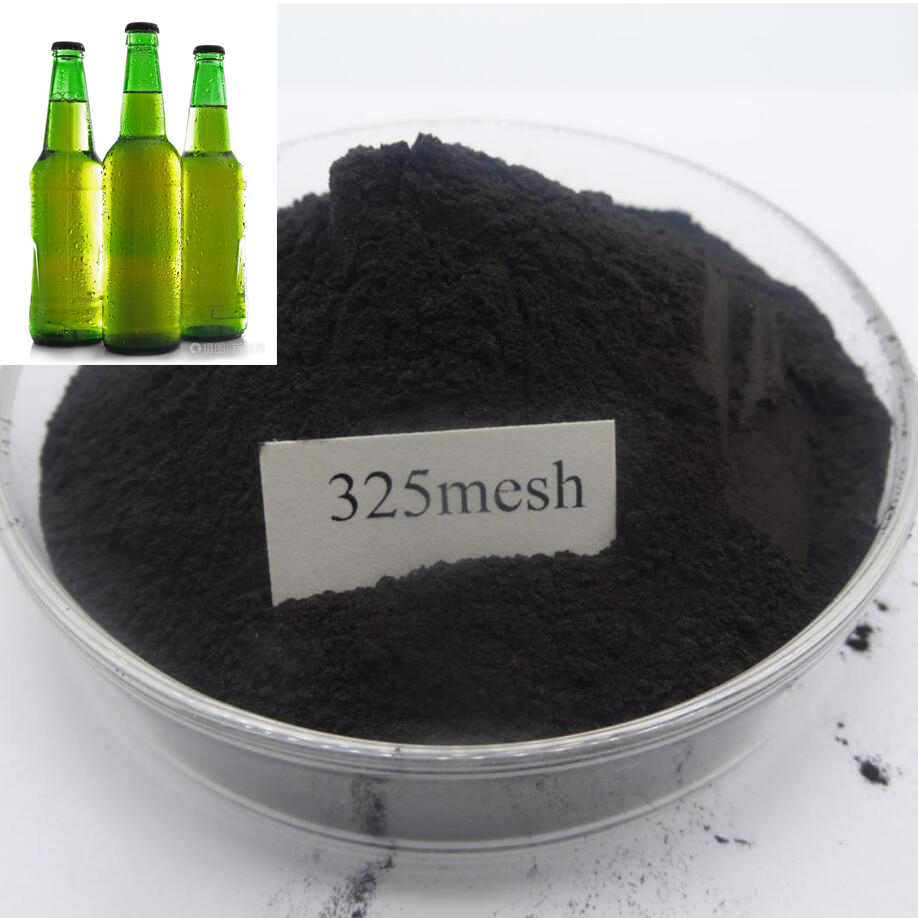
The Purpose and Function of Adding 325mesh Chromite Powder To Glass Bottle Production
325mesh chromite powder is the most commonly used green mineral coloring material for sodium-calcium-silicon glass bottles. Beer olive green bottles are its largest application, and its purpose is not simply aesthetics, but also coloring and light blocking.
1. Core Function: Ion Coloring, Producing Olive Green
At high melting temperatures, Cr³⁺ trivalent chromium ions in the ore powder dissolve in the glass network, absorbing the red and blue wavelengths of visible light and transmitting the green-yellow wavelengths, forming the classic olive green/tea green.
Natural chromite contains iron impurities. The synergy between iron and chromium produces the yellowish olive green of beer bottles. If pure chemical chromium oxide is used, the color will be a bright emerald green, different from the traditional beer bottle hue.
⚠️ If the furnace atmosphere becomes reducing, it transforms into Cr²⁺ divalent chromium, causing the glass to become bluish-gray, rendering the color unusable.
2. UV Protection (Most Important Practical Function)
Beer, fruit wine, and beverages are highly sensitive to ultraviolet (UV) light: UV rays accelerate the oxidation of proteins and hops in the beverage, producing a sun-dried odor and causing spoilage.
Colorless glass offers almost no protection against UV rays;
Olive-green glass, colored with chromium and iron, strongly absorbs 300-400nm UV light, preventing light from damaging the contents and extending shelf life.
This is the industrial reason why most beer bottles are green, not just for aesthetics.
3. Comparison: Why use chromite powder instead of chemical Cr₂O₃?
Cost Advantages: 325mesh chromite powder is significantly cheaper than chemically produced chromium oxide, making it ideal for large-tonnage bottle and jar glass production, where low cost is crucial.
Color Matching: 325mesh chromite powder is often accompanied by Fe₂O₃ iron oxide, resulting in the desired olive beer green color. Pure chromium oxide produces a bright green, not the color ideal for beer bottles.
Disadvantages: Minerals contain impurities, and poor particle size control can easily lead to chromium spinel inclusions, black spots, and discoloration. High precision is required in powder fineness, mixing uniformity, and melting temperature.
4. Other Secondary Functions
Auxiliary Color Adjustment in Black Glass Bottles: The primary coloring agent for black glass is the iron-manganese/sulfur-carbon system. A small amount of chromium ore powder (0.2-0.6%) slightly adjusts the blackness and base color. Chromium ore cannot be used alone to make black glass
In trace amounts, it slightly improves the thermal stability of the glass, but this is a secondary effect and not intended as an additive.
325mesh chromite powder: