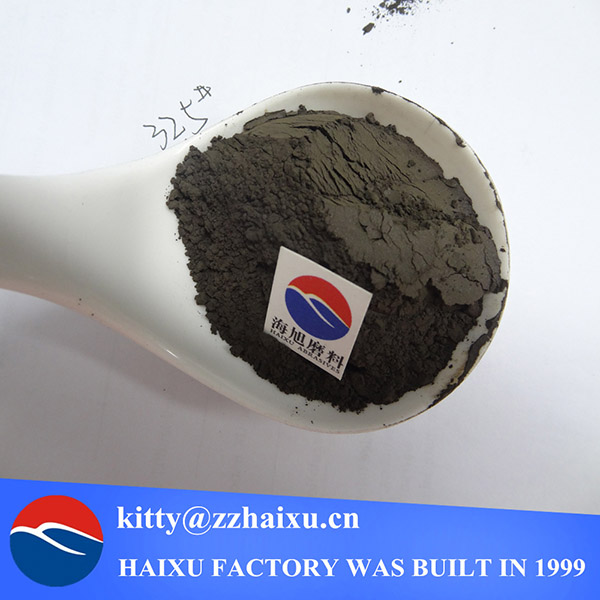
Why can 325#mesh chromite powder be used in precision casting?
325#mesh chromite powder has a particle size of 45µm-0 and a typical throughput of 90%, but 100% throughput chromite powder can be custom-made.
325#mesh chromite powder is suitable for precision casting due to its unique advantages:
* Excellent resistance to metal penetration: High thermal conductivity allows molten metal in contact with the mold to solidify rapidly into a “shell,” preventing further penetration into the sand grains.
* Neutral chemical properties: Inert to Fe, Mn, and Cr oxides, and does not react with most alloys, making it particularly suitable for casting stainless steel, high-manganese steel, and high-chromium steel.
* High refractoriness (>1900℃): Much higher than the pouring temperature of cast steel, resulting in good high-temperature strength of the mold shell.
* Low coefficient of thermal expansion: The mold shell is dimensionally stable and less prone to cracking, making it especially suitable for casting large or complex castings.
* Good chilling effect: Refines the surface grains of the casting, improving surface hardness and wear resistance.
Main uses of chromite powder in precision casting:
In investment casting, chromite powder is mainly used to formulate face or back refractory coatings, and to make the mold shell.
Face Coating: This is the most critical layer, directly contacting the high-temperature molten metal. A fineness of 325 mesh (approximately 45 micrometers) is ideal for face coatings because it can:
Achieve an extremely smooth casting surface: The fine powder has good filling properties, replicating the fine texture of the wax model.
Form a dense inner layer of the mold shell: Effectively prevents molten metal penetration, avoiding “sand adhesion” defects.
Good chemical stability: It does not undergo redox reactions with elements such as Cr, Ni, and Mn in common alloys (such as stainless steel and high-alloy steel), avoiding surface defects such as “pitting” and “wrinkling.” This is a major advantage over zircon powder, especially when casting high-alloy steel.
Back Coating: Due to its high refractoriness and low coefficient of thermal expansion, it is also commonly used as a back coating to enhance the overall strength, deformation resistance, and thermal shock resistance of the mold shell.
Sanding material: Coarser chromite sand (such as 70-140 mesh) is often used for sanding the surface or back layer to enhance the air permeability and mechanical strength of the shell.