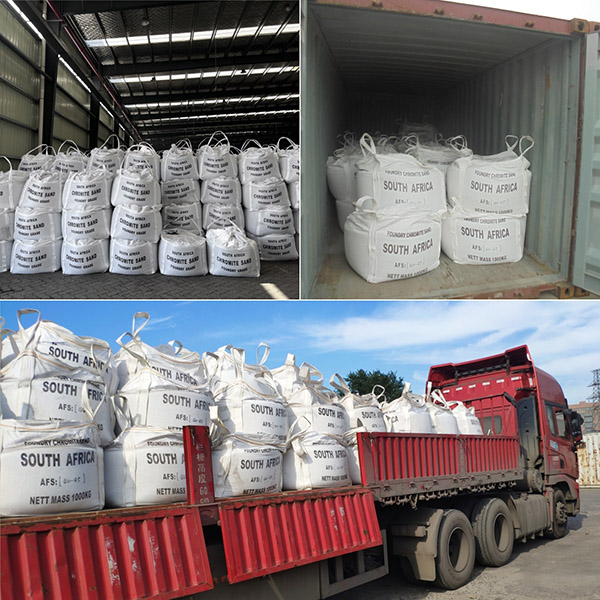
Why chromite sand 0-1mm 1-3mm 3-5mm can be used as refractory material?
Chromite sand 0-1mm 1-3mm 3-5mm can be used as refractory material, because it’s high purity-Cr2O3>46%, high refractory temperature, Ideal material for use as refractory materials in high-temperature kilns.
Raw material is from South Africa, we can product these sizes for refractory material: 0-1mm 1-3mm 3-5mm 325#, 200#, 400#mesh.
1. High Melting Point: The theoretical melting point of pure chromite is as high as 2180°C.
In practical applications, the refractoriness (the temperature at which it begins to soften under load) of chromite sand is typically also above 1900°C.
This allows it to withstand the high-temperature environments of most metallurgical processes (such as steelmaking) and casting processes.
2. Excellent Chemical Stability (Neutral Properties): This is the most prominent and important characteristic . In the field of refractory materials, materials are generally classified as acidic (such as silica sand SiO₂), basic (such as magnesia MgO), and neutral.
Neutral Properties: Chromite sand has good resistance to both acidic and basic slags and is not easily chemically reacted with them.
Why it’s Important: During the smelting process, slags with varying chemical compositions are generated. If the refractory material is acidic, it is easily corroded by basic slags; and vice versa. As a neutral refractory material, can be widely used in kilns with various chemical environments, demonstrating strong adaptability.
Specific Applications: It is often used as a separating layer between basic refractories (such as magnesia bricks) and acidic refractories (such as silica bricks) to prevent direct contact and reaction at high temperatures, which could damage the furnace lining.
3. Good Solid-State Sintering Ability
At high temperatures, it’s particles can bond together through solid-state diffusion, forming a strong sintered layer.
This gives refractory bricks or ramming mixes made from chromite sand high high-temperature strength and good volume stability, making them less prone to shrinkage or softening at high temperatures.
4. Resistance to Metal Penetration
In the foundry industry, chromite sand has poor wettability to molten metals (especially steel and iron) and their oxides.
This means that molten metal has difficulty penetrating into the pores between sand particles, effectively preventing sand adhesion defects in castings and resulting in castings with a smooth surface.
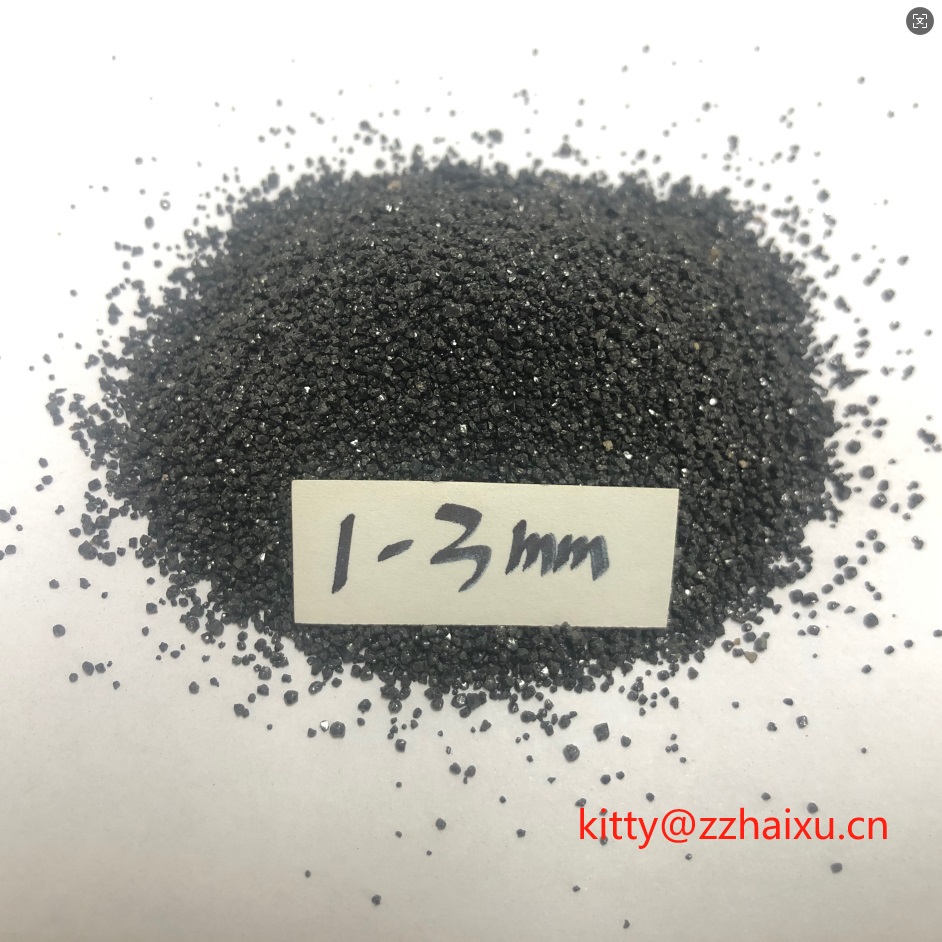
Chromite sand 1-3mm:
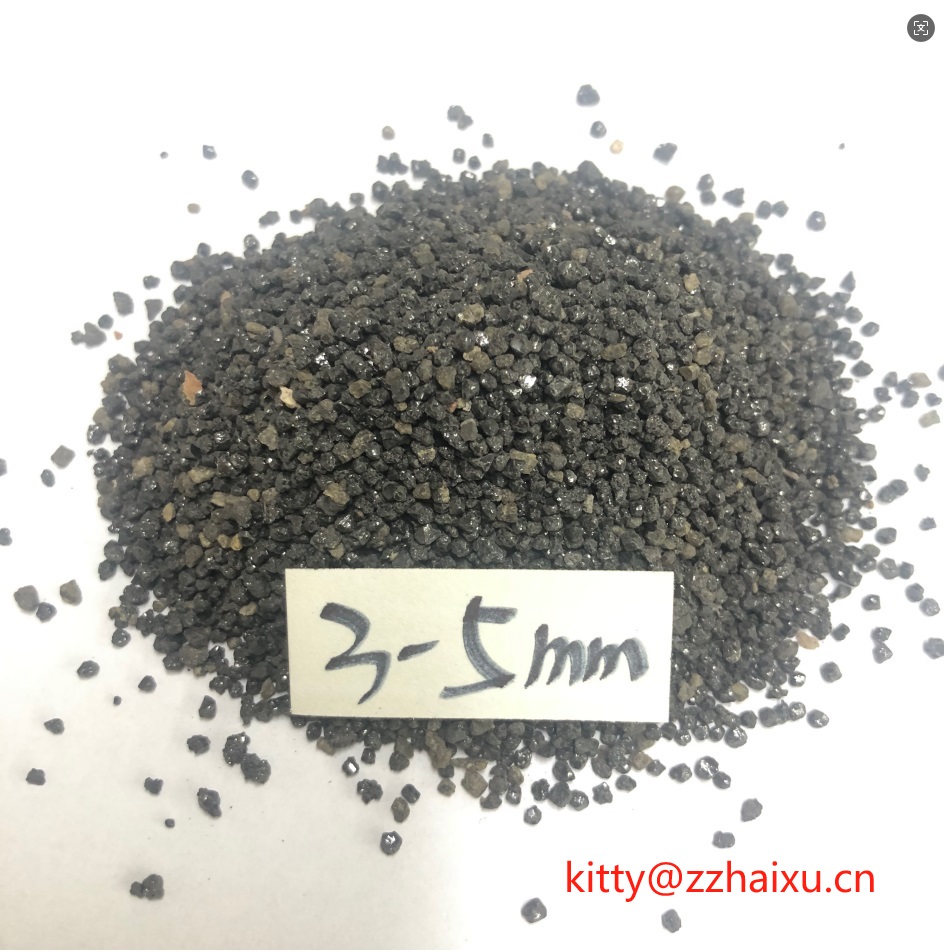
Chromite sand 3-5mm:
Typical Chemical Analysis:
| Cr2O3 | ≥46.0% |
| SiO2 | ≤1.0% |
| FeO | ≤26.5% |
| CaO | ≤0.30% |
| MgO | ≤10.0% |
| Al2O3 | ≤15.5% |
| P | ≤0.003% |
| S | ≤0.003% |
| Cr/Fe | 1.55:1 |
Typical Physical Properties:
| Bulk Density | 2.5-3g/cm³ |
| Volume Density | 4.0-4.8g/cm3 |
| Color | Black |
| PH Value | 7-9 |
| Sintering Temperature | >1,800°C |
| Melting Point | 2,180°C |